Physical Address
Sydney, Australia 2564
Physical Address
Sydney, Australia 2564
Global PV waste could reach 297–402 million tonnes by 2060, creating a major recycling challenge and a new materials opportunity. India alone could generate up to 35.2 million tonnes.
Solar has become one of the defining technologies of the energy transition. Global installations continue to rise at extraordinary speed. Module prices have fallen, manufacturing has scaled, and solar now provides some of the world’s cheapest electricity. But every solar module installed today will eventually reach the end of its working life, ultimately creating solar waste.
A new study published in Nature puts this solar waste challenge into perspective. The researchers estimate 297–402 million tonnes of cumulative global PV waste by 2060. The study goes much further than estimating waste volumes. It asks who will recycle those modules, where recycling will happen, and who will capture the economic value.
That is where the story becomes much more interesting.
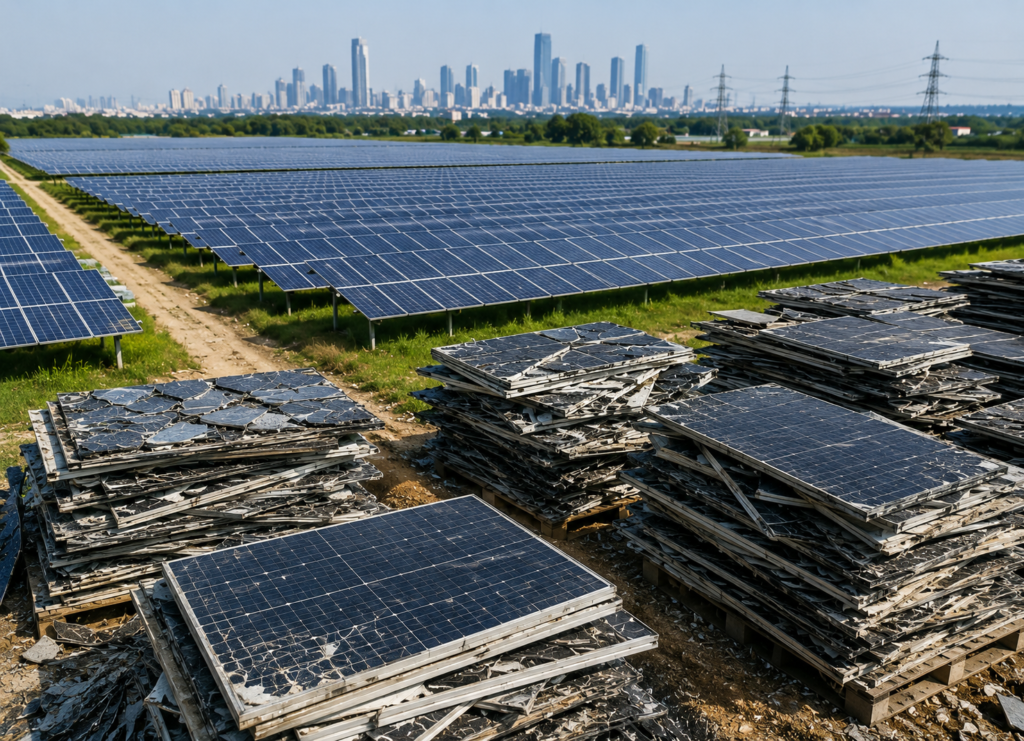
For the next decade or so, high-income countries will generate much of the world’s PV waste, which is not surprising. Europe, Japan, and the United States were among the earliest markets to install solar at scale. The geography then changes quickly. By 2060, China could generate 112.8–160.5 million tonnes of PV waste. That represents roughly 36–40% of the global total.
India too becomes a significant contributor. It is estimated that India will generate 26.8-35.2 million tonnes of PV trash by 2060, accounting for 8.6-9.2% of global PV waste. Those numbers deserve attention. India is installing solar at an enormous scale today. In effect, it is also creating the feedstock for a future recycling industry.
The question is whether India will build that industry before the waste arrives.
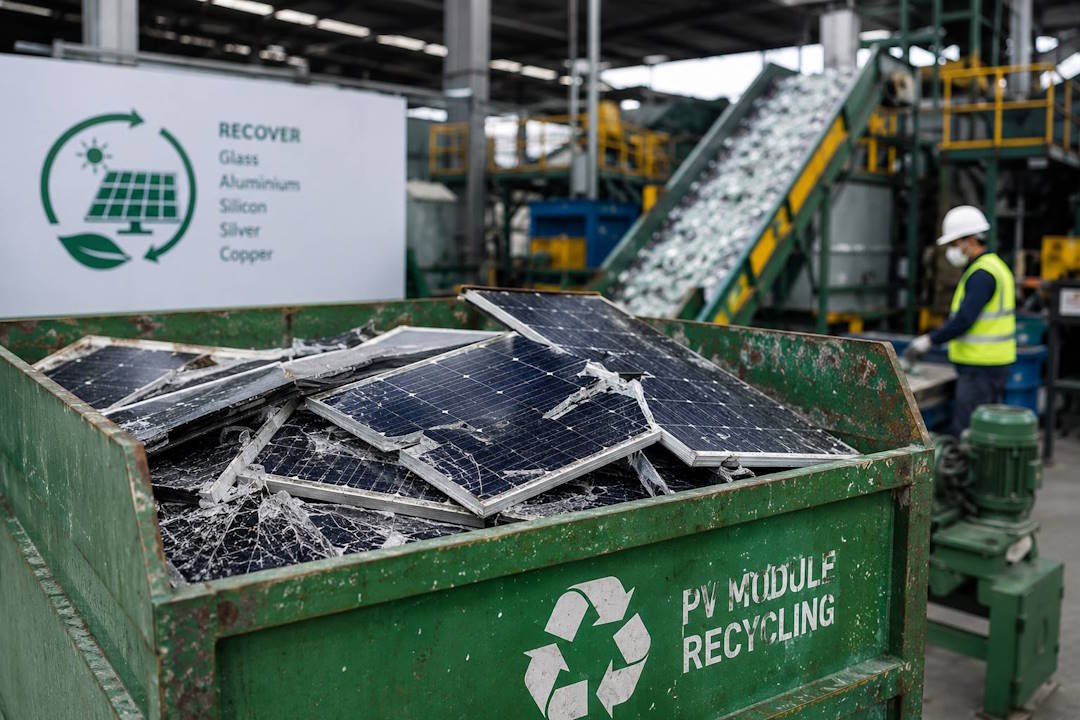
Solar modules contain plenty of recyclable material. Glass and aluminium account for much of their weight. Modules also contain smaller quantities of silicon, silver and copper. Those smaller quantities matter. Glass and aluminium are relatively easy to recover. Recovering valuable materials at high purity is much harder. This exposes a weakness in conventional recycling targets. A facility may recover most of a module by weight and still lose much of its economic value.
The Nature study compares mechanical, thermal and chemical recycling pathways for such solar waste. Each has different costs, recovery rates and carbon impacts. Mechanical recycling is usually simpler and cheaper. However, it performs less well when the goal is high-value material recovery. Thermal and chemical approaches can recover more valuable materials. They also require more sophisticated equipment and greater investment. It has been found that pathways with more thermal recycling produced stronger economic and climate outcomes than business-as-usual recycling.
That changes the central question. It is no longer simply: Can we recycle a solar panel?
The better question is how much value can we recover from it?
PV recycling is not always commercially attractive today. That could change considerably over the next decade. It is estimated that recycling reaches economic break-even between 2035 and 2040 across the modelled scenarios. Two forces drive this change. First, recovered materials become more valuable. Second, recycling costs fall as facilities scale and technologies improve.
According to the experts, the benefits of recycling will be between $132 and $304 per tonne in 2030. By 2040, they might rise to as high as US$457 per tonne. At the same time, technological learning could sharply reduce processing costs. This creates a difficult timing problem.
The industry needs infrastructure before waste volumes become large. Yet those early facilities may struggle to make money. Governments therefore need to think about recycling capacity well before 2040.
Not every country will develop advanced solar waste recycling facilities. That means retired modules could increasingly cross borders. From an economic perspective, this can make sense. Waste can move to regions with better technology, larger facilities and lower processing costs. This approach has potential to significantly improve global recycling outcomes.
Under the strongest-performing scenarios, cumulative net economic benefits reach US$529.1–935.5 billion by 2060. The same scenarios could avoid 2.2–3.32 billion tonnes of CO₂-equivalent emissions. Those are substantial gains.
But there is a catch. Countries with mature recycling industries capture more of the value. Countries without this capability may just export their retired modules. A total trade-off. Sending waste to the most efficient recycler can maximise global value. It can also concentrate that value in relatively few regions. That issue will become harder to ignore as solar waste grows across developing economies.
India sits in an unusual position. It is expanding solar deployment, building domestic manufacturing, and heading towards one of the world’s largest PV waste streams. That combination creates an opportunity.
India could treat retired modules mainly as a waste-management problem. Or it could treat them as a source of secondary raw materials. The second option has much greater strategic value. Silver, copper, aluminium and silicon recovered from old modules can return to manufacturing or other industries. But basic dismantling will not be enough. India will need better separation, purification and refining technologies. It will also need systems for collection, transport and traceability.
Silicon is a good example. Solar-grade silicon requires extremely high purity. Recycled silicon often falls short because removing carbon and metallic impurities remains difficult. That can push recovered silicon into lower-value applications rather than new solar cells. This is therefore more than a waste problem. It is also an R&D, manufacturing and materials opportunity.
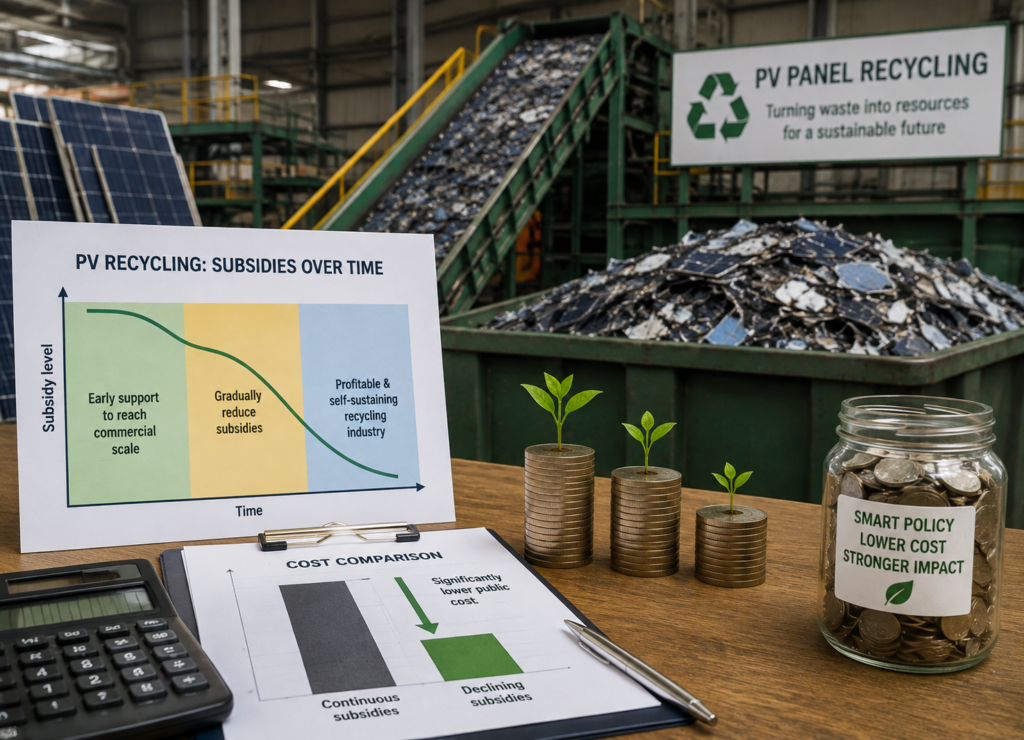
The early years of PV recycling are likely to be the hardest. Waste volumes are still relatively small, recycling plants need significant upfront investment, and the economics are not yet attractive enough to drive large-scale private investment. This is where targeted government support can make sense. But that support should reduce as the industry becomes commercially viable.
The numbers make the case quite clearly. A declining subsidy approach could require only US$0.4–1.9 billion cumulatively by 2060, compared with around US$16 billion if subsidies were maintained continuously. That means similar outcomes could potentially be achieved with only 2.9–11.9% of the spending.
The policy direction is straightforward: use public funding to help PV recycling cross the difficult early stage, build capacity and bring costs down, and then gradually step away as the market becomes capable of standing on its own.
Many recycling policies focus on the percentage of a product recovered by weight. That sounds sensible. But solar modules expose the weakness of this approach. Glass and aluminium make up most of a module’s mass. Silver and silicon represent much smaller fractions. Yet these materials can carry far greater economic and strategic value.
A weight-based target can therefore produce impressive recycling numbers without creating a truly circular supply chain. The Nature study argues for greater attention to specific high-value materials. That means asking different questions. How much silver did the process recover? What happened to the silicon? What purity did the recovered materials achieve? Can manufacturers use those materials again?
These metrics could become far more important than simply reporting the percentage of a panel recycled.
Not every retired solar panel needs immediate recycling. Some modules can continue operating. Reuse can extend their productive life and delay demand for recycling infrastructure. It can also reduce the need to manufacture replacement panels. That makes reuse particularly interesting for markets with limited recycling capacity.
However, second-life modules bring their own challenges. Their performance varies. Remaining lifetime can be uncertain. Buyers also need confidence in safety and reliability. For now, reuse works best as a complementary strategy. Modules with useful life remaining can stay in service. Truly end-of-life modules can then enter formal recycling systems.
For two decades, solar companies have competed on efficiency, manufacturing scale and module cost. The next phase could add another metric: material recovery.
By 2060, hundreds of millions of tonnes of PV modules could enter the waste stream. Those modules contain materials the solar industry will still need. Countries that build advanced recycling industries can recover some of that value domestically. Countries that wait may end up exporting both their waste and its economic value.
For India, the projected 26.8–35.2 million tonnes of PV waste makes this more than a distant environmental issue. It could become a major clean-technology industry. But the infrastructure, skills and policies need to start developing well before those waste volumes peak.
The 402 million tonnes figure is eye-catching, but the more important message is what happens before that waste arrives.
PV recycling is likely to become economically attractive at roughly the same time that very large volumes of retired modules begin appearing in China, India and other fast-growing solar markets. That creates a narrow window for governments and industry to build collection systems, recycling capacity and materials markets before the waste volumes become difficult to manage.
The countries that move early will not simply avoid a waste problem. They could recover aluminium, glass, silicon, silver and other valuable materials, reduce the need for virgin resources, and create an entirely new industrial value chain around solar.
Those that move late will still inherit the same millions of tonnes of retired modules. The difference is that much of the economic value may already have been lost.
Question for readers: As India builds one of the world’s largest solar fleets, should recycling capacity now become part of solar manufacturing and deployment policy rather than something addressed only at end-of-life?
Original study: Chen Wang et al., Towards an equitable future of global photovoltaic waste recycling, Nature, 2026.