Physical Address
Sydney, Australia 2564
Physical Address
Sydney, Australia 2564
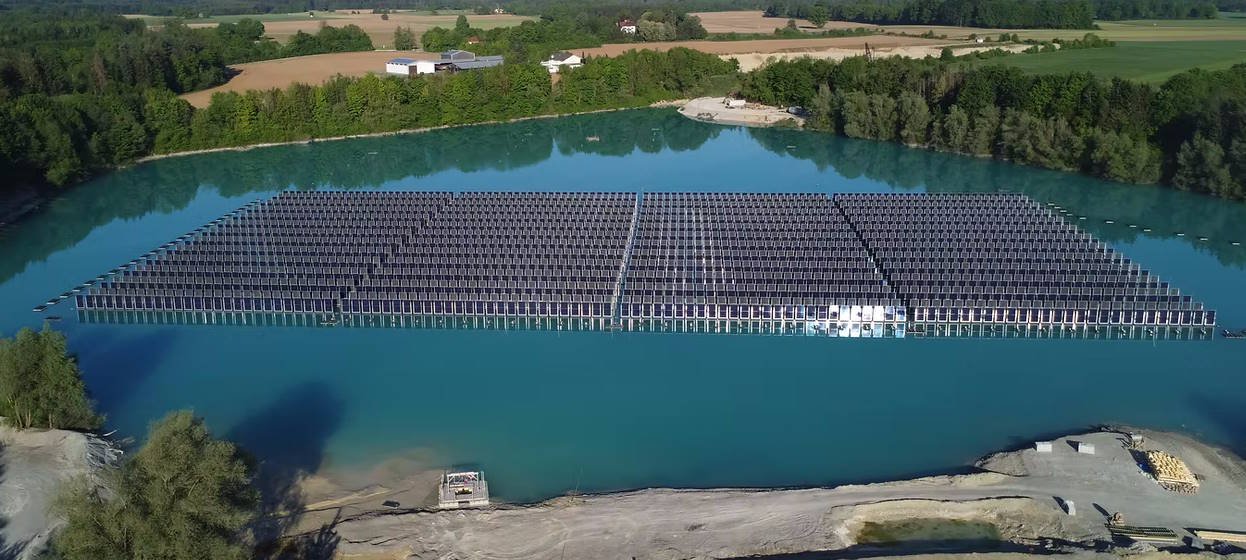
Germany has added another world-first to its renewable energy record. In the Bavarian town of Gilching, SINN Power has commissioned the world’s first vertical floating photovoltaic (PV) plant, a 1.87 MW system generating about 2 GWh of electricity per year.
What sets this project apart is not its size, but its orientation: the panels stand upright on water.
Installed on a quarry lake at the Jais gravel pit, this vertical floating PV plant occupies only 4.65% of the lake’s surface area, yet supplies nearly 70% of the facility’s annual electricity needs.
SINN Power’s patented SKipp-Float system achieves a more balanced generation profile by arranging the panels vertically in an east–west orientation. This allows the vertical floating PV system to capture sunlight both in the morning and evening hours when conventional tilted systems typically underperform.
The modules are anchored to a keel-like substructure extending 1.6 meters below the surface. This narrow underwater base stabilizes the structure, allowing each row to flex gently under wind pressure, an innovation that significantly improves storm resistance. Electricity is delivered via a floating cable network connected to a shore-based feed-in point.
The project’s design aligns with Germany’s Federal Water Resources Act, staying far below the 15% surface coverage limit for floating installations.
Early environmental monitoring indicates the system not only avoids ecological harm but may actually enhance water quality. Increased oxygen exchange and light penetration have promoted natural water circulation, while fish and nesting birds have been observed around the floating platforms.
SINN Power attributes this to the vertical design, which allows air and sunlight to reach the water surface, preventing stagnation and supporting aquatic life.
With its modular, scalable architecture, the SKipp-Float system can be adapted for gravel pits, reservoirs, and other artificial lakes with depths of 1.6 meters or more.
The design’s flexibility also opens the door for offshore and coastal applications, where resistance to storms and waves is essential.
For energy-intensive industries like quarrying, the technology offers tangible savings. Partner company Kies- und Quetschwerk Jais GmbH & Co. KG reported that grid electricity consumption has already dropped by about 60% and is expected to reach 70% once the system operates at full capacity.
The project was officially inaugurated in the presence of Bavarian Minister-President Markus Söder and Minister of Economic Affairs Hubert Aiwanger, demonstrating the region’s commitment to innovative clean technologies.
A second expansion phase of 1.7 MW is already planned, which will keep total lake coverage below 10%.
The project’s success reinforces Bavaria’s leadership in renewable innovation and positions Germany as a pioneer in dual-use PV solutions, integrating clean energy generation with environmental stewardship.
The world’s first vertical floating solar plant demonstrates that solar doesn’t have to compete with land or ecology. By standing upright on water, it uses space more intelligently and harmoniously.
As global energy demands rise and land scarcity grows, vertical floating PV could become a blueprint for next-generation solar farms, from quarry lakes to coastal basins and beyond.