Physical Address
Sydney, Australia 2564
Physical Address
Sydney, Australia 2564

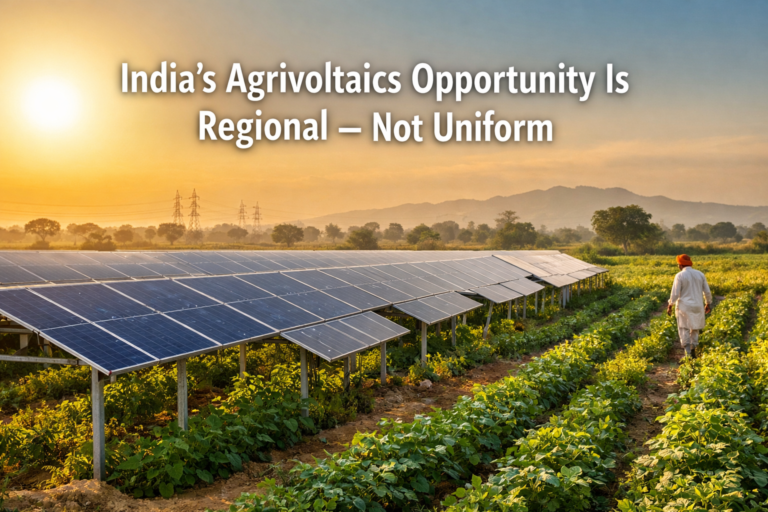
Agrivoltaics is often explained in simple terms: solar panels above crops.
That description worked at the beginning. However, it no longer captures what the field has become.
As agrivoltaics expands beyond small pilot projects, a deeper problem is emerging. Policymakers struggle to regulate it. Investors struggle to evaluate it. Farmers struggle to see how it applies to their land. The issue is not the technology itself. Instead, it is the lack of clear language.
This is why a recent proposal from researchers at Universiti Malaysia Pahang Al-Sultan Abdullah is important. Rather than introducing a new technology, the team proposes something more fundamental: a taxonomy for agrivoltaics.
At first, names like cowvoltaics or fishvoltaics may sound informal. Yet behind these terms lies a serious shift. Agrivoltaics is no longer being treated as one idea. It is being recognised as a family of systems with different purposes and outcomes.
That distinction matters.
Until now, agrivoltaics has often been grouped into one broad category. A project either qualifies as agrivoltaic or it does not. In reality, this approach creates confusion.
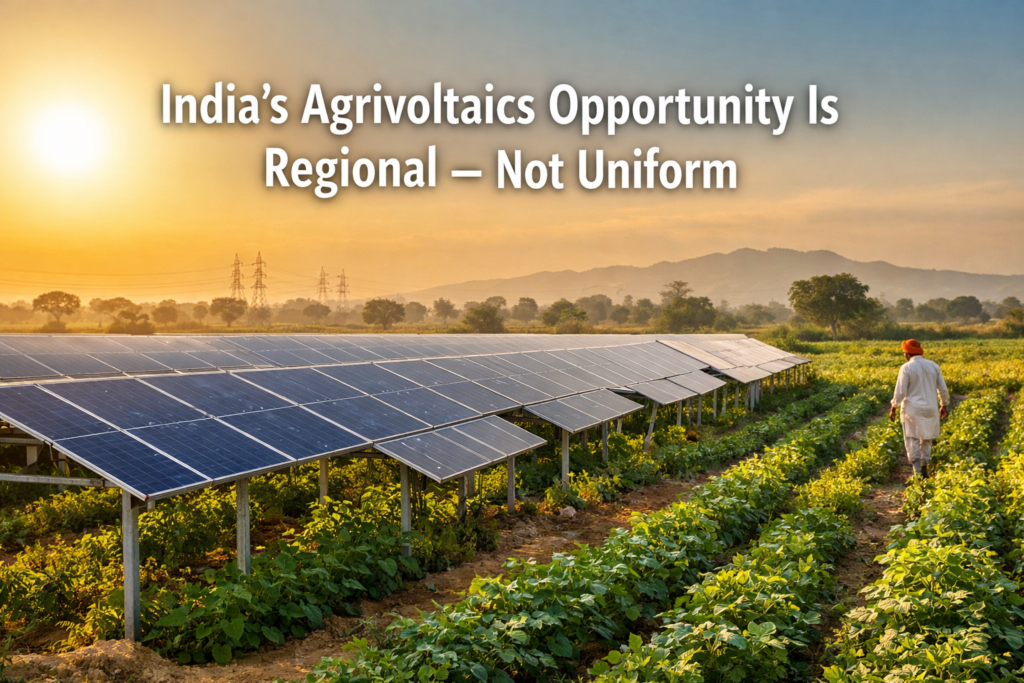
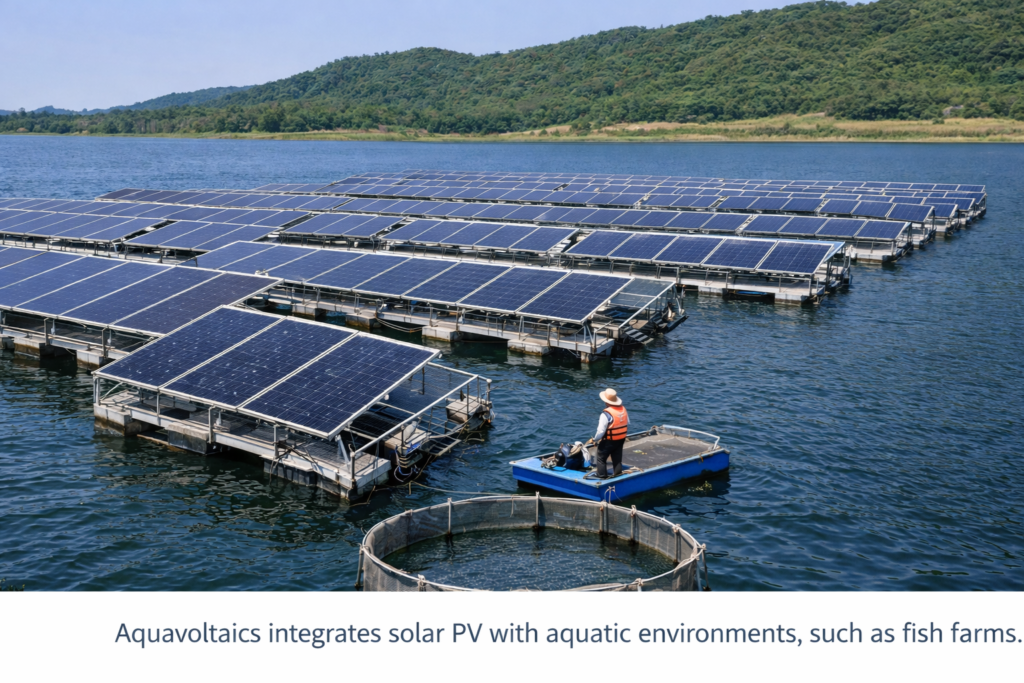
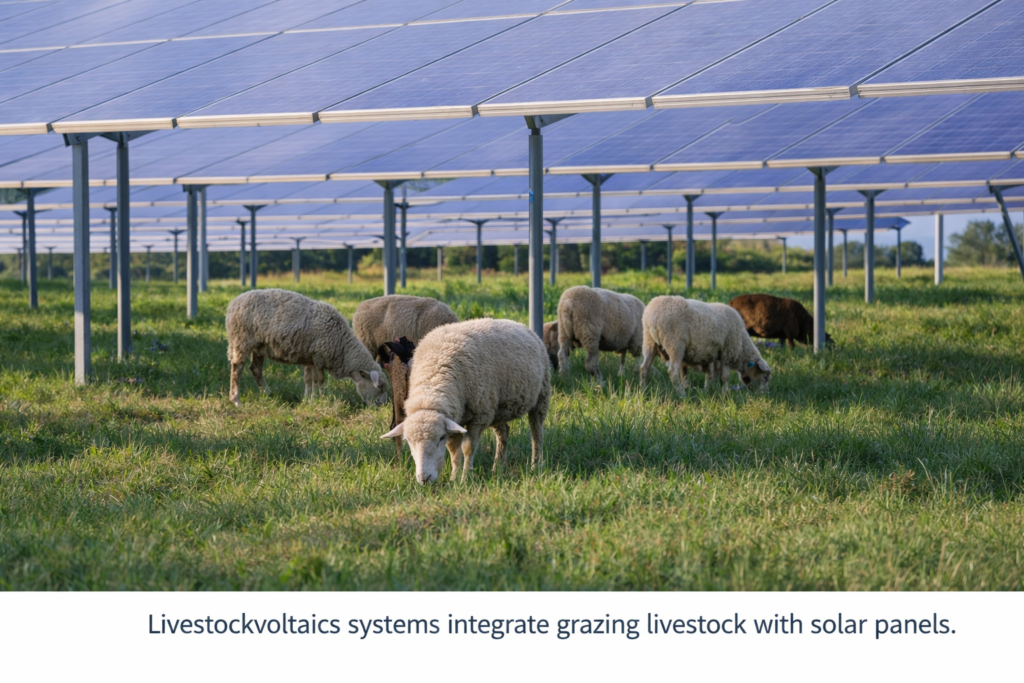
For example, growing vegetables under elevated panels is very different from grazing sheep beneath solar arrays. Likewise, floating solar above fish ponds follows a completely different logic. Still, under many current frameworks, all these systems are treated the same.
The new taxonomy separates agrivoltaics into four clear groups:
Each category involves a different interaction between solar infrastructure and living systems. Because of this, each category also requires different design rules, performance metrics, and management practices.
In short, agrivoltaics is no longer just about sharing land. It is about designing systems that work with nature rather than around it.
One of the biggest challenges facing agrivoltaics today is regulation. Most land-use laws are binary. Land is either agricultural or industrial. Agrivoltaics does not fit neatly into either box.
A clear taxonomy helps regulators move beyond vague definitions. Instead of asking whether a project is “agrivoltaic,” policymakers can ask more practical questions.
For instance, does a livestockvoltaic system maintain animal welfare? Does a crop-based system protect yields and soil health? Does an aquavoltaic project improve water quality and ecosystem stability?
By asking the right questions, regulators can create targeted rules instead of broad restrictions. As a result, permitting becomes faster, and uncertainty decreases.
Without this clarity, agrivoltaics risks remaining stuck in pilot mode. With it, scaling becomes possible.
Agrivoltaics is often seen as complex. From an investment perspective, that complexity increases risk. However, complexity becomes manageable when systems are clearly defined.
Each category in the taxonomy maps to a different business logic.
Livestockvoltaics can reduce heat stress, improve pasture conditions, and support methane reduction strategies. Crop-based agrivoltaics can stabilise yields, lower water use, and protect crops from extreme weather. Aquavoltaics can improve panel efficiency through water cooling while supporting fish production. Zoovoltaics can offset energy use and support conservation and education efforts.
Investors rarely invest in ideas. They invest in repeatable models. A taxonomy makes those models easier to identify and compare.
Perhaps the most important shift introduced by this work is conceptual.
The researchers frame agrivoltaic systems not only as energy generators, but as part of ecological systems. This changes how solar infrastructure is viewed.
Instead of occupying land, solar panels become tools that shape microclimates, manage water, and support biodiversity. In this framing, energy generation is no longer the only outcome. Environmental performance becomes equally important.
This opens the door to new forms of value. Biodiversity credits, conservation funding, and nature-positive finance all become relevant. As a result, agrivoltaics begins to align with broader sustainability goals, not just renewable energy targets.
Zoovoltaics may appear unusual at first. However, its importance lies in visibility rather than scale.
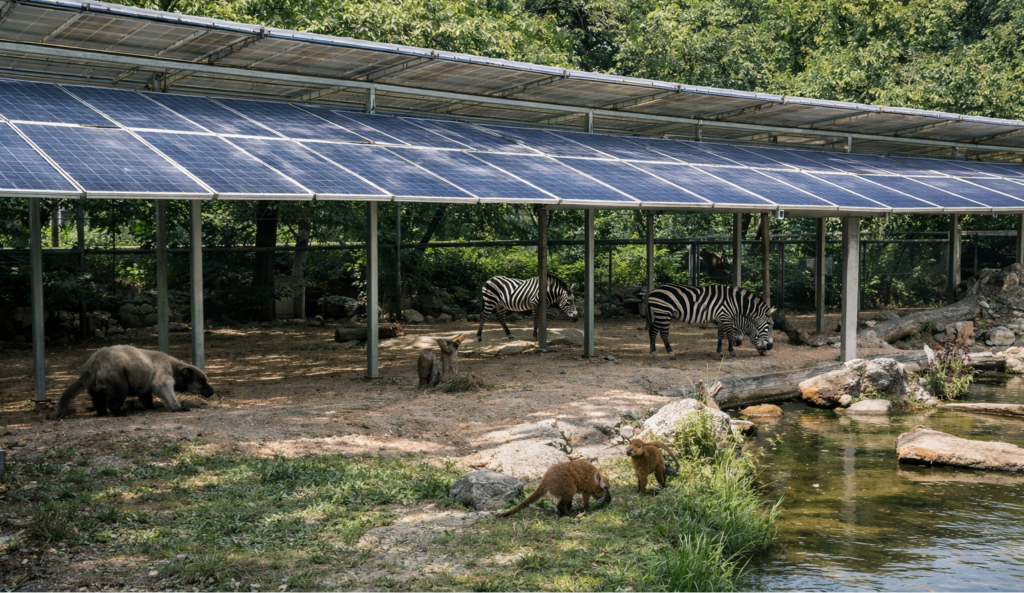
Zoos are public spaces. They are energy-intensive and strongly linked to conservation and education. Integrating solar systems into zoo environments does more than reduce emissions. It helps the public understand how renewable energy can coexist with biodiversity.
In that sense, zoovoltaics is less about animals and more about social acceptance. It turns abstract sustainability concepts into something people can see and experience.
That visibility matters for any technology aiming to grow.
Early-stage technologies rely on simple definitions. Mature fields require structure.
Agrivoltaics is now moving from the question, “Can solar and agriculture coexist?” to a more advanced one: “How should solar be designed for different living systems?”
This taxonomy is an early signal of that transition. It reflects a field that is diversifying, expanding, and becoming more serious about long-term deployment.
A taxonomy alone will not remove policy barriers or solve design challenges. Still, it provides a foundation. It gives researchers, policymakers, developers, and farmers a shared language.
And shared language enables coordinated action.
As agrivoltaics continues to evolve, its success will depend on more than panel efficiency. It will depend on how well solar systems integrate into agricultural, ecological, and social environments.
This taxonomy does not end the conversation. Instead, it marks the point where the conversation becomes more focused and more useful.