Physical Address
Sydney, Australia 2564
Physical Address
Sydney, Australia 2564
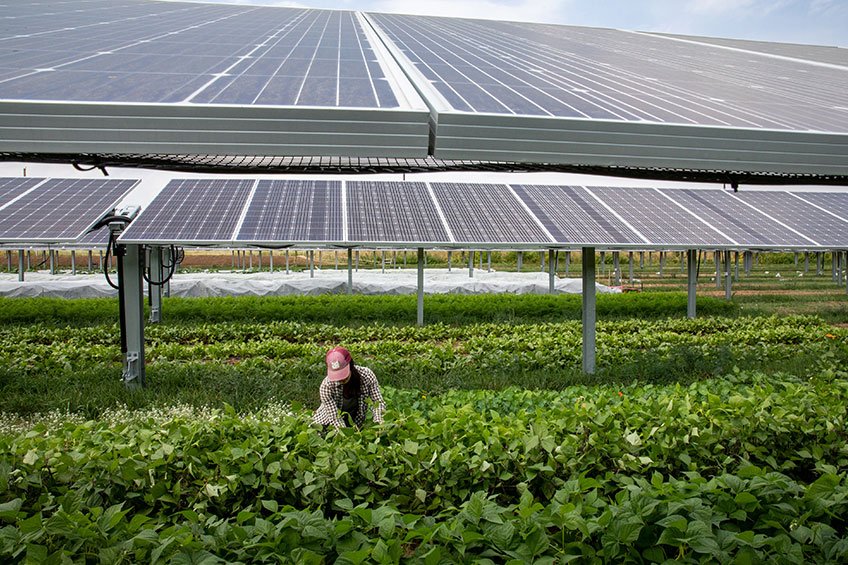
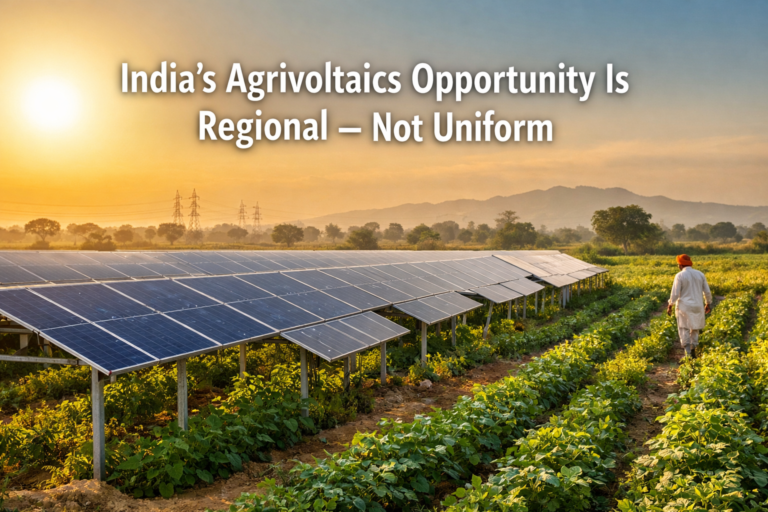
Picture this; you are driving through farmland on a sunny day. Usually, you would see endless rows of crops soaking up the heat, but this time something unusual catches your eye. The rows of solar panels tilt like giant umbrellas, shading the crops growing underneath. It looks futuristic, but it’s not. This is real and being deployed all around the world.
It’s agrivoltaics, where farmers are doubling up: growing food and producing clean electrcity on the same land.
But here’s the big question: Is this actually worth the money, or just another pricey green experiment?
Agrivoltaics (also called agriphotovoltaics, agrophotovoltaics, agriPV or APV) is basically multitasking with land. Instead of choosing between crops or solar panels, farmers use the same land for both. In most cases, the panels are raised so a tractor can slip under. Sometimes they track the sun. Sometimes they stand vertical like hedgerows to let wind and machinery pass. The form changes; the idea doesn’t: one hectare, two incomes. The key is choosing the right fit for your farm; just like picking the right tool for a job.
According to the International Renewable Energy Agency (IRENA), this method can increase land productivity by up to 70% compared to traditional single-use farming. Imagine your backyard garden, but instead of just a trellis for your tomatoes, you have got solar panels 2–4 meters above, giving you both shade and power.
A growing body of university work, much of it in hot, arid regions, shows the logic. Shading can soften heat spikes, crops can use less water, and panels can even run cooler and a touch more efficient. Studies led by the University of Arizona, for example, documented better water savings and improved crop performance under arrays compared with open fields.
Here’s the part that makes most farmers pause: the upfront investment. National Renewable Energy Laboratory (NREL)’s benchmark work puts utility-scale ground-mount PV at roughly about US$1/W (directionally), with commercial-scale systems somewhat higher, before you add the extra steel, spacing and civial works that dual-use designs need. In practise, that means a megawatt lands around the low-seven figures (approxiamtely US$1.1-1.5 million) and a 50 kW farm-scale system sits in the mid-five to low-six figures, depending on site, structure height, fencing and grid work. That’s enough to make anyone think twice.
Though that sounds heavy until you remember that you are not just buying solar panels. You are essentially investing in a dual-income property like owning an apartment building where one tenant (the energy buyer) pays rent while you keep running your farm.
Now to the good part what do you actually earn back?
1) You sell the power: Annual generation depends on sun and design. Using NREL reference capacity-factor ranges, a 1 MWac array in a strong-sun location can deliver on the order of ~1.5–2.2 GWh/year. Price it at local wholesale/retail or under a PPA and you’ve got the energy line of the P&L.
2) You lease the land: Developers often pay hundreds to a couple thousand US dollars per acre per year, shaped by grid access and market maturity. If you’re early to the party or near a substation, rates improve.
3) You count the crop benefits: Under panels, heat-sensitive varieties can hold yields better through hot spells; some trials report higher output or significantly lower irrigation demand for leafy greens and specialty crops. Results vary by cultivar and layout, but the direction of travel, less water, steadier yield, shows up repeatedly in peer-reviewed and agency-backed work.
Vineyards are a vivid case: recent French trials with agronomically steered, dynamic shading in drought years recorded notable yield lifts for certain varieties, while “max-electricity” tracking layouts sometimes under-performed agronomically, proof that design intent matters.
Payback isn’t a single number; it’s a map. If you finance smartly, layer incentives, and design to your farm’s loads, 6–10 years is a realistic band many developers underwrite for ag-adjacent PV in good markets. Push to taller structures, heavy civil works or deep grid upgrades and the line moves right. The flip side: the system can de-risk your farming, shade as climate insurance, power as price hedge.
Policy matters too. In India, for example, PM-KUSUM remains a major lever for farm-scale solar (pumps, feeders, micro-plants), with updated support extended through 2026; the strongest outcomes pair incentives with load-matching and simple O&M.
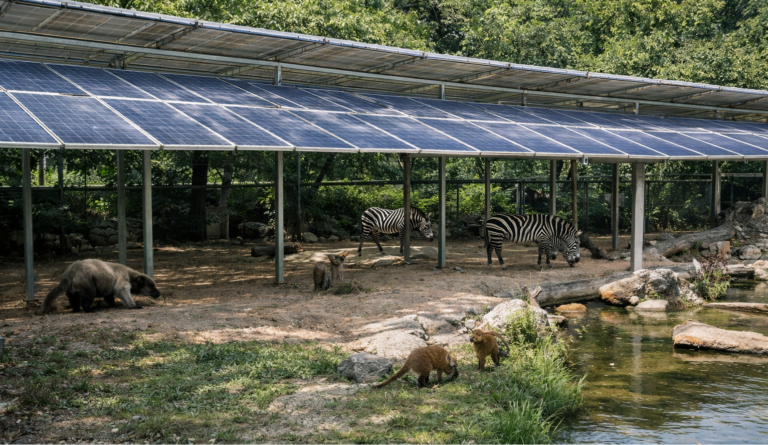
It wins with heat-stressed horticulture, grazing under arrays (sheep beat mowers on O&M), pollinator corridors, nurseries and high-value specialty crops. It’s tougher with broadacre cereals unless you go very high and very sparse, at which point your capex per watt rises and the energy case weakens. Site, slope, soil, water and market all decide who smiles.
We spoke with researchers at Western Sydney University, the University of New South Wales (UNSW) in Sydney, and Arizona State University (ASU) in the U.S. Their consensus: farmers should run through a clear checklist before committing to agrivoltaics.
Chase simple money. Grants, green banks, cooperatives and PPAs beat exotic finance nine days out of ten.
Design for the farm first. Match array size to pumps, cool-rooms, processing loads; bank the self-consumption.
Pick the right crop under the right geometry. Leafy greens and vines are rarely angry at shade; corn and wheat often are.
Model water and heat. Shade saves water, but airflow and row spacing matter.
Cost the steel honestly. Height and spans add dollars—charge them to the benefits they unlock.
Big picture? Agrivoltaics could reshape farming as we know it.
The United Nations Food and Agriculture Organization says food production must rise 70% by 2050 to feed the world. At the same time, farming must cut its environmental impact. Agrivoltaics is one of the few technologies that addresses both, food security and clean energy.
Even the EU’s Green Deal names agrivoltaics as a key tool for reaching climate neutrality by 2050.
For farmers ready to adapt, this isn’t just about surviving the next season, it’s about building long-term resilience, extra income, and sustainability.
The question isn’t if agrivoltaics will go mainstream, it’s who will jump in early and reap the benefits first.
Agrivoltaics isn’t just about panels and crops, it’s about the future of farming. For farmers who are ready to innovate, the numbers, the science, and the real-world stories suggest it’s not just viable, it’s potentially transformative.
So, what do you think? Would you consider solar panels as the next addition to your farm toolkit?