Physical Address
304 North Cardinal St.
Dorchester Center, MA 02124
Physical Address
304 North Cardinal St.
Dorchester Center, MA 02124

As solar and wind energy grow fast, we need better ways to store electricity. For years, lithium-ion batteries have done the job. But they can be expensive, catch fire, and use rare metals. Now, a team of scientists led by Professor Shizhang Qiao at the University of Adalaide in Australia have built a new kind of battery that might solve all these problems.
Say hello to the zinc–iodine battery — a safer, cheaper, and more sustainable option for large-scale energy storage.
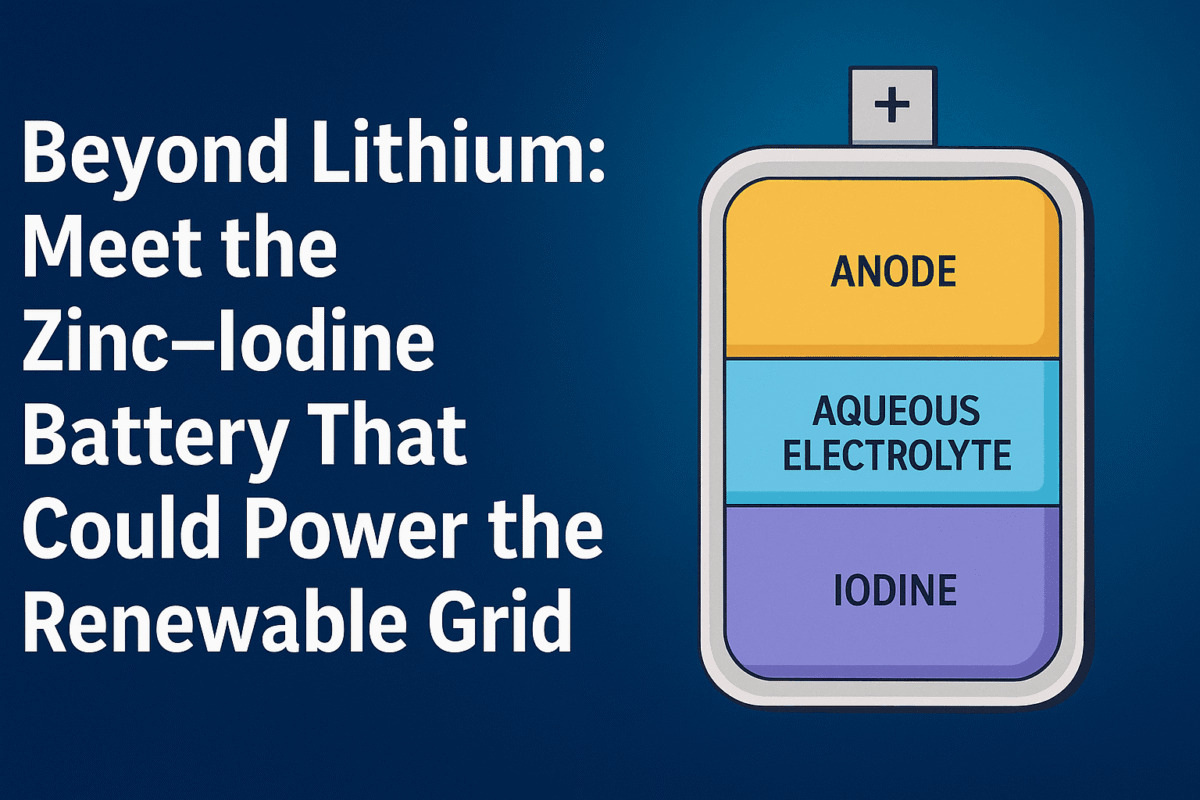
This new battery uses zinc (a common metal) and iodine (found in salt and seaweed) to store energy. Instead of using flammable liquids like lithium batteries, it uses water-based materials, making it much safer.
Key parts:
These materials are abundant, non-toxic, and much easier to recycle.
At the heart of this innovation is a clever new way to build battery electrodes. Instead of using messy liquid chemicals, researchers at the University of Adelaide developed a dry electrode process—they rolled powdered materials into thick, dense layers that can store much more energy than traditional designs. This approach allows them to pack in up to 100 milligrams of active material per square centimeter, a big leap compared to conventional batteries.
But they didn’t stop there. To improve battery safety and lifespan, they introduced a small additive called 1,3,5-trioxane into the electrolyte. This molecule forms a thin, flexible film on the zinc surface during charging, which stops the formation of dendrites—tiny metal spikes that can cause batteries to short-circuit or even catch fire.
The result? A battery that lasts for over 750 charging cycles while maintaining nearly 90% of its capacity. It’s safer, more stable, and significantly cheaper to produce than lithium-ion batteries—especially for the kind of large-scale, stationary energy storage needed to support solar and wind power.
The team published their results in the journal Joule
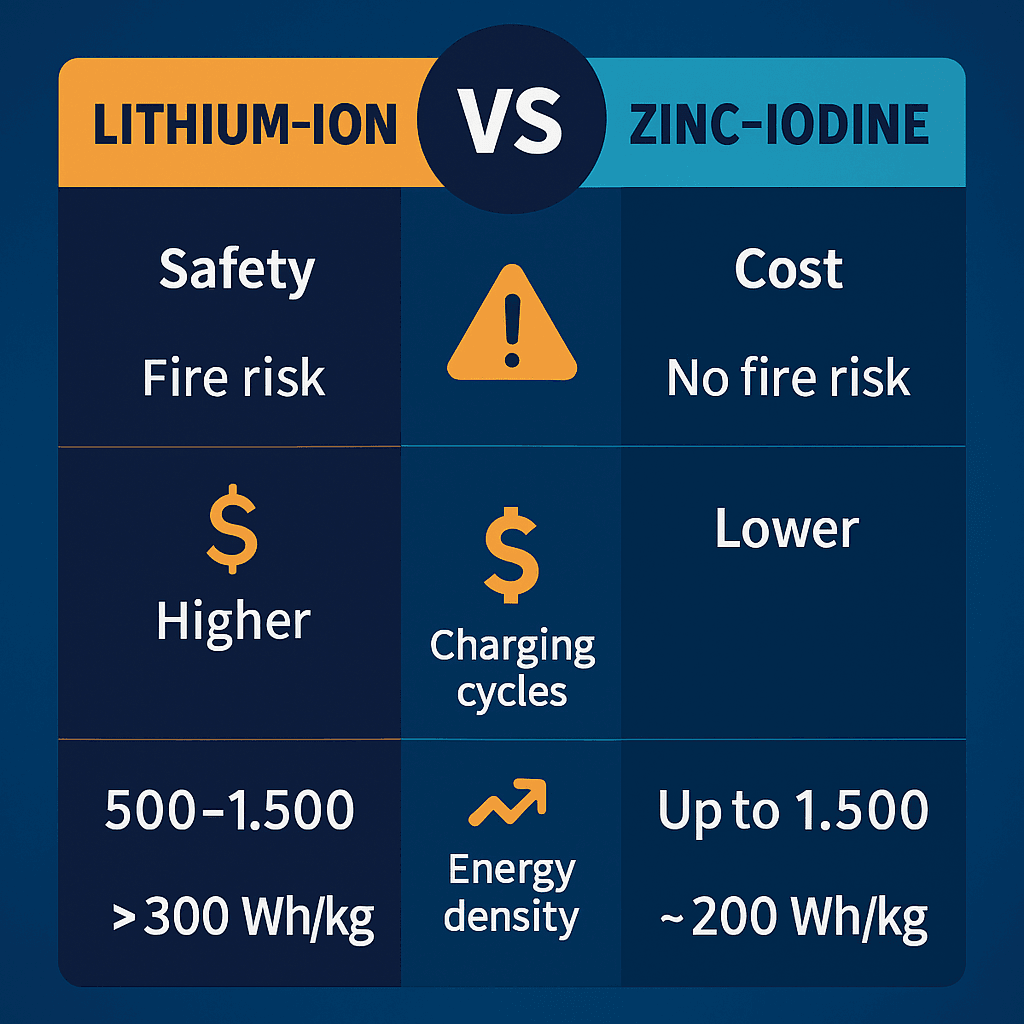
Lithium-ion batteries are great, but they have issues:
| Feature | Lithium-Ion Battery | Zinc–Iodine Battery |
|---|---|---|
| Fire Risk | 🔥 High | ✅ Very low |
| Cost | 💰 Expensive | 💸 Affordable materials |
| Recycling | ⚠️ Difficult | ✅ Easy to recycle |
| Water-Based | ❌ No | ✅ Yes |
| Ideal for Grid Use | ⚠️ Needs safety checks | ✅ Safe & scalable |
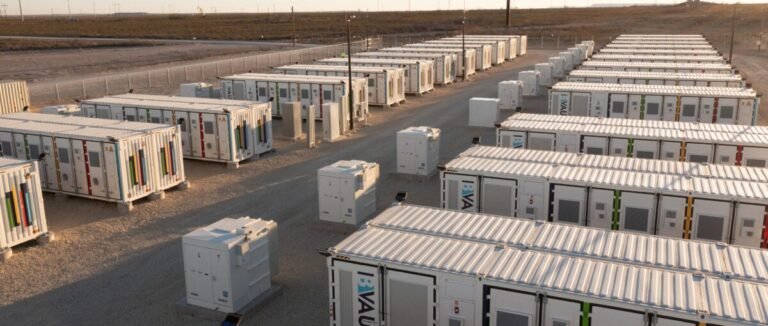
Zinc–iodine batteries are particularly well-suited for large-scale, stationary applications where safety, cost, and longevity matter most. They offer a compelling solution for storing solar and wind energy during the day and releasing it when the sun sets or wind slows. In remote farms, villages, or off-grid locations that lack consistent electricity access, these batteries could provide reliable backup power. Likewise, during emergencies or natural disasters, they could serve as stable, fire-safe backup systems. While you won’t see them in your phone or laptop anytime soon, these batteries have the potential to power entire neighborhoods or even cities in a cleaner and safer way.
The research team is now focused on making these batteries even more powerful. Their current goal is to double the system’s energy density by fine-tuning battery components and reducing excess materials.
Dr. Han Wu said, “they’re also working on scaling up production through reel-to-reel manufacturing—a high-speed method used in large-scale battery fabrication”.
Looking beyond iodine, they are exploring similar battery architectures using other halogens like bromine, which could unlock even more performance improvements in the future.
As we scale up renewable energy, the world urgently needs energy storage technologies that are not only powerful, but also safe, affordable, and environmentally friendly. Zinc–iodine batteries may be one of the most promising answers. They’re simple, scalable, and—thanks to water-based chemistry—much safer than today’s lithium-ion counterparts.
“This zinc–iodine system shows that we don’t need to rely solely on lithium for energy storage,” said Professor Shizhang Qiao, who led the research at the University of Adelaide. “Our battery is safer, greener, and ideal for the growing demand in grid-scale storage.”
In a world racing toward net-zero, this innovation could be the missing puzzle piece to store clean energy more effectively—and power the future without compromise.