Physical Address
Sydney, Australia 2564
Physical Address
Sydney, Australia 2564
Energy Taiwan 2025 offered a glimpse into how Taiwan’s solar, wind, and AI industries are aligning to build a more resilient, net-zero energy system.
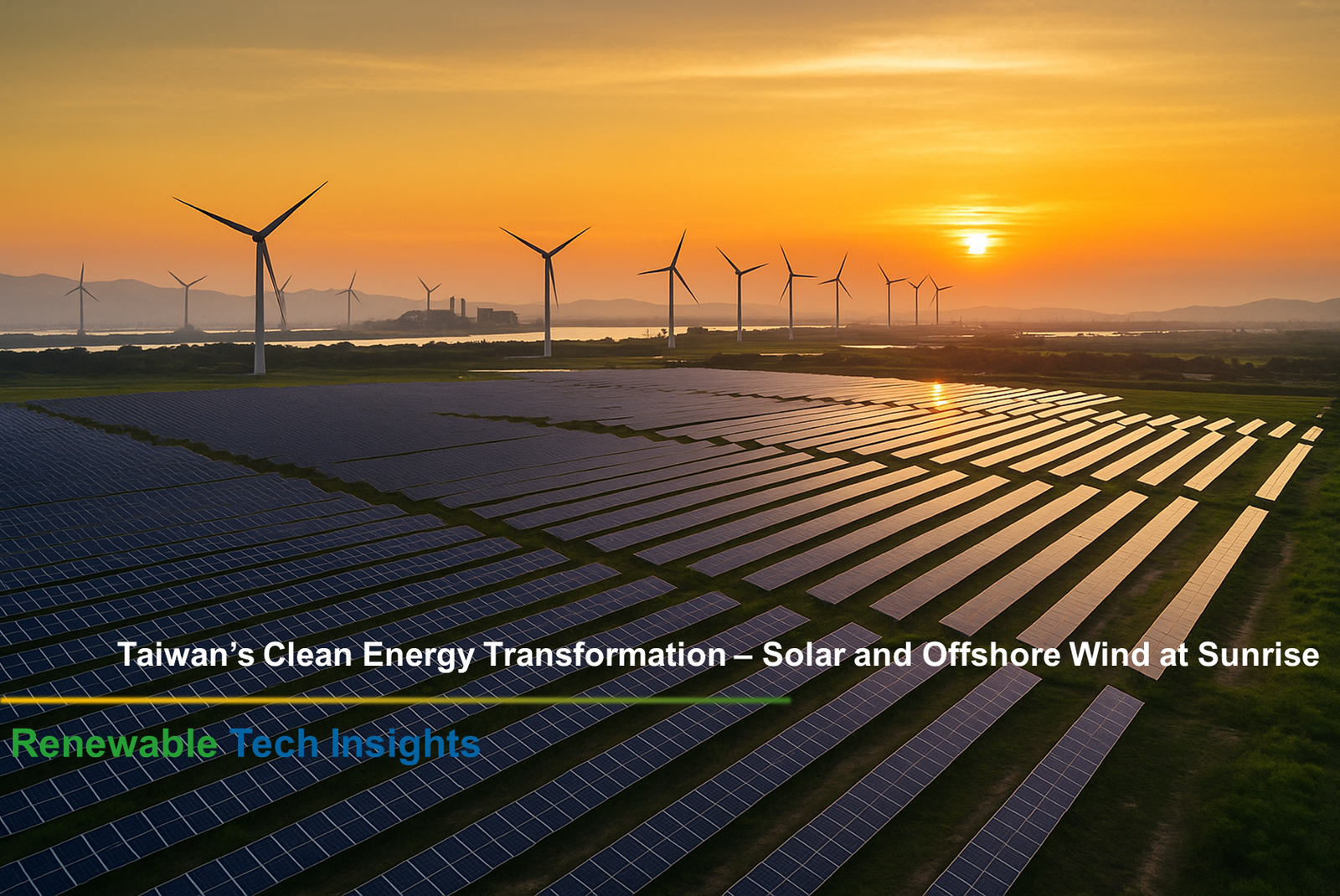
At the crossroads of Asia’s digital and energy revolutions, Energy Taiwan & Net-Zero Taiwan 2025 offered a clear view of the future.
The event in Taipei drew more than 28,000 visitors and 600 international buyers. It showed how Taiwan’s technology-driven economy is now leaning on solar, offshore wind, and energy storage to power its next phase of growth.
Artificial intelligence and cloud computing are creating record electricity demand. Typhoons and new global trade rules are adding pressure. For Taiwan, where semiconductors and AI hardware drive exports, clean power has become an economic necessity, not just a sustainability goal.
Semiconductor leader TSMC, along with Apple and Nvidia, is already signing renewable-energy purchase agreements to meet RE100 targets by 2030.
Each new fabrication plant is a massive power consumer. SEMI Taiwan calls them “energy monsters.”
At the same time, the EU’s Carbon Border Adjustment Mechanism (CBAM) and similar U.S. measures are reshaping supply chains. Green credentials now influence export success as much as product quality.
Corporate energy buyers dominated discussions at the 2025 expo. From electronics to finance, companies are looking for stable renewable sources that can run 24/7. Solar and storage remain the backbone of Taiwan’s plan to decarbonize its industries.
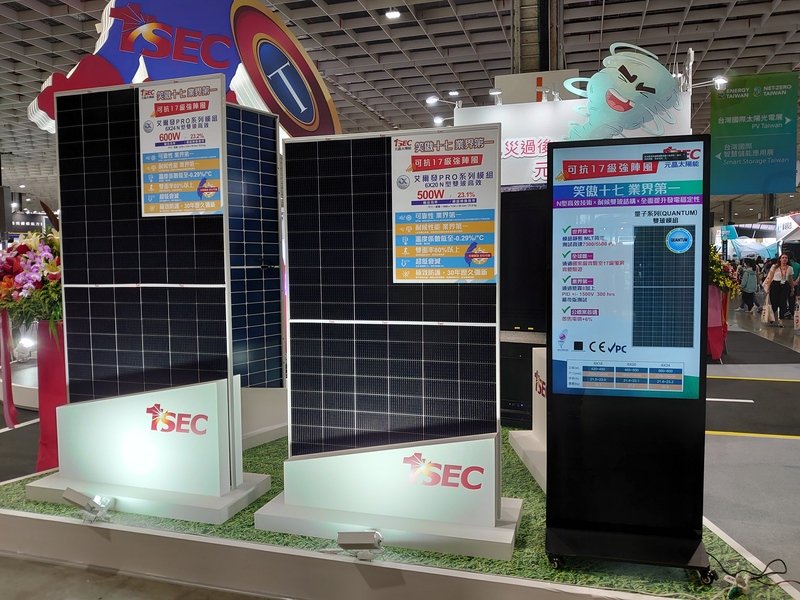
Solar dominated the exhibition floor. It wasn’t just about generating power, it was about proving resilience.
Taiwanese manufacturers displayed TOPCon modules, typhoon-proof frames, and floating systems built for humid, high-wind conditions.
After Typhoon Danas damaged 130,000 panels earlier this year, the government began reviewing floating-solar safety rules. Companies such as TSEC and Sun Rise used the event to present improved, non-toxic materials designed to exceed new regulations.
Taiwan’s feed-in tariff for systems under 10 kW continues to support households, while the national goal of 20 GW solar by late 2026 pushes larger projects forward. Growth has slowed slightly before municipal elections, yet Taiwan’s field experience under tough weather gives its exporters an edge.
Manufacturers report demand from Japan’s coastal markets, where corrosion resistance is crucial. The transition from PERC to TOPCon cells confirms that Taiwan is moving from assembly to true PV innovation.
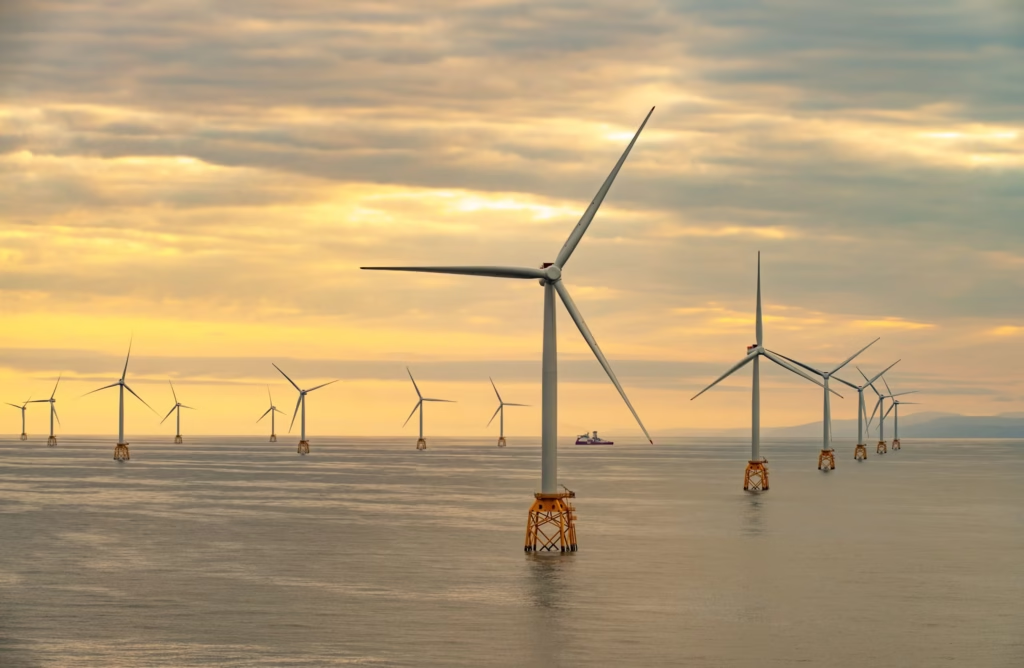
While solar led in numbers, offshore wind embodied Taiwan’s long-term vision.
The country already has 4 GW installed and aims for 10.9 GW by 2030.
A major highlight was the UK Pavilion, marking 20 years of bilateral cooperation. Organized by the British Chamber of Commerce in Taipei and Scottish Development International, it showcased expertise from seabed engineering to training programs.
Officials from Taiwan’s Energy Administration said British know-how will accelerate the island’s 2050 net-zero goal.
For developers such as Synera Renewable Energy, offshore wind is more than diversification, it’s the foundation of a low-carbon export economy.
Chairman Lucas Lin put it bluntly: “Decarbonization is not just a moral choice; it’s how Taiwan stays competitive.”
The sector also strengthens Taiwan’s geopolitical role. Blending foreign expertise with domestic manufacturing positions the island as a vital link in the Indo-Pacific clean-energy chain
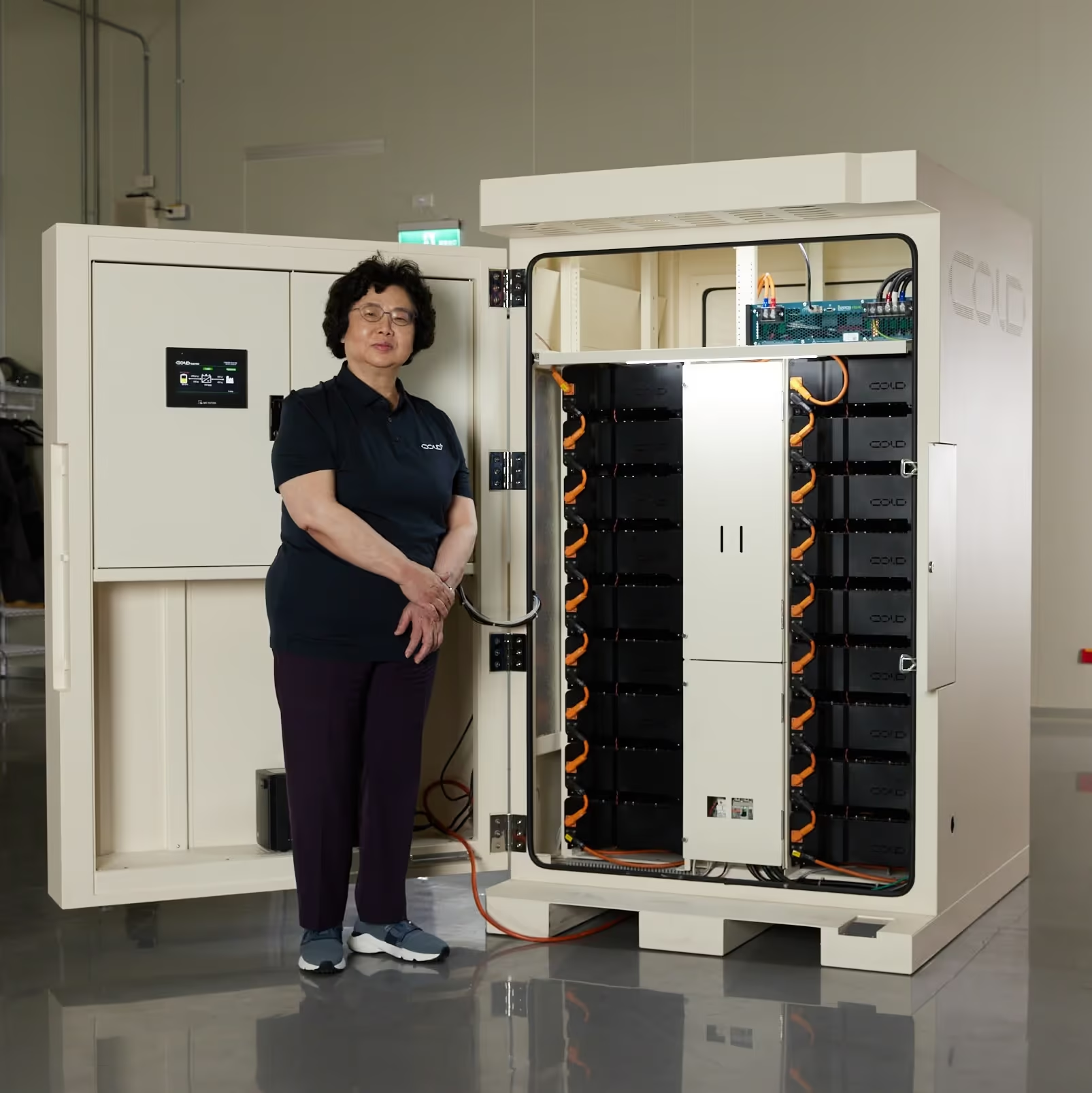
Typhoons and power cuts made energy storage a top priority this year.
Extreme weather has pushed rural communities toward off-grid and behind-the-meter systems that keep lights on when the grid fails.
Local innovators are filling the gap. Cold Electric displayed its “fully made in Taiwan” LFP batteries, engineered to operate at low temperatures. These can be shipped pre-charged to disaster zones, restoring power immediately after storms.
Meanwhile, Sunshine Electric is selling more hybrid inverter-storage packages to farmers and small businesses seeking energy independence.
The takeaway: energy security and climate resilience now go hand in hand.
As Taiwan scales up to 20 GW of solar and 10.9 GW of wind, storage capacity will decide how reliable that clean power really is.
With global module prices near record lows, Taiwanese manufacturers face intense competition. They are responding with smarter strategies instead of price wars.
In the United States, pending Foreign Entity of Concern (FEOC) rules could favour Taiwanese exports if stricter restrictions hit neighbouring countries. In Europe, CBAM and RE100 policies are driving local demand for certified green energy.
Producers such as URE and TSEC now use dual-manufacturing models: high-spec modules made in Taiwan for regulated markets, and lower-cost lines assembled elsewhere for price-sensitive buyers.
These moves show a shift from survival mode to strategic positioning, where innovation and compliance matter as much as cost.
Despite market headwinds, optimism ran high at the expo. Many see the overlap of AI, renewables, and policy support as the spark for a new growth cycle.
Taiwan’s unique mix of precision manufacturing and clean-tech integration may soon become its most valuable export.
Energy Taiwan 2025 demonstrated that the clean-energy story is no longer about single technologies. It’s about integration, connecting data, infrastructure, and finance into one ecosystem.
This year’s show featured hydrogen, carbon-credit trading, and AI-based energy management, reflecting a maturing climate economy.
With more than 22 GW of green capacity already online, Taiwan’s next challenge is coordinating variable renewables with industrial demand and grid stability.
Doing so will require smart forecasting, flexible storage, and new market tools that value both electrons and carbon data.
Taiwan’s progress matters far beyond its shores. Its ability to balance industrial competitiveness with climate accountability could define how Asia’s manufacturing giants decarbonize.
The 2025 exhibition left no doubt: for Taiwan, clean energy is not just policy, it’s identity, resilience, and global relevance.
As AI accelerates and the climate grows less predictable, could Taiwan’s model of innovation and resilience become a blueprint for the rest of Asia’s clean-energy future?


Leave a Reply